
Materials · 8 min read
Spotted Gum vs Merbau: Which Is Better?
Both can make a good hardwood deck. The better choice depends on the colour you want, the surrounding surfaces and the timber you can actually source.
Written by Elliot, carpenter and owner of Fine Design Co
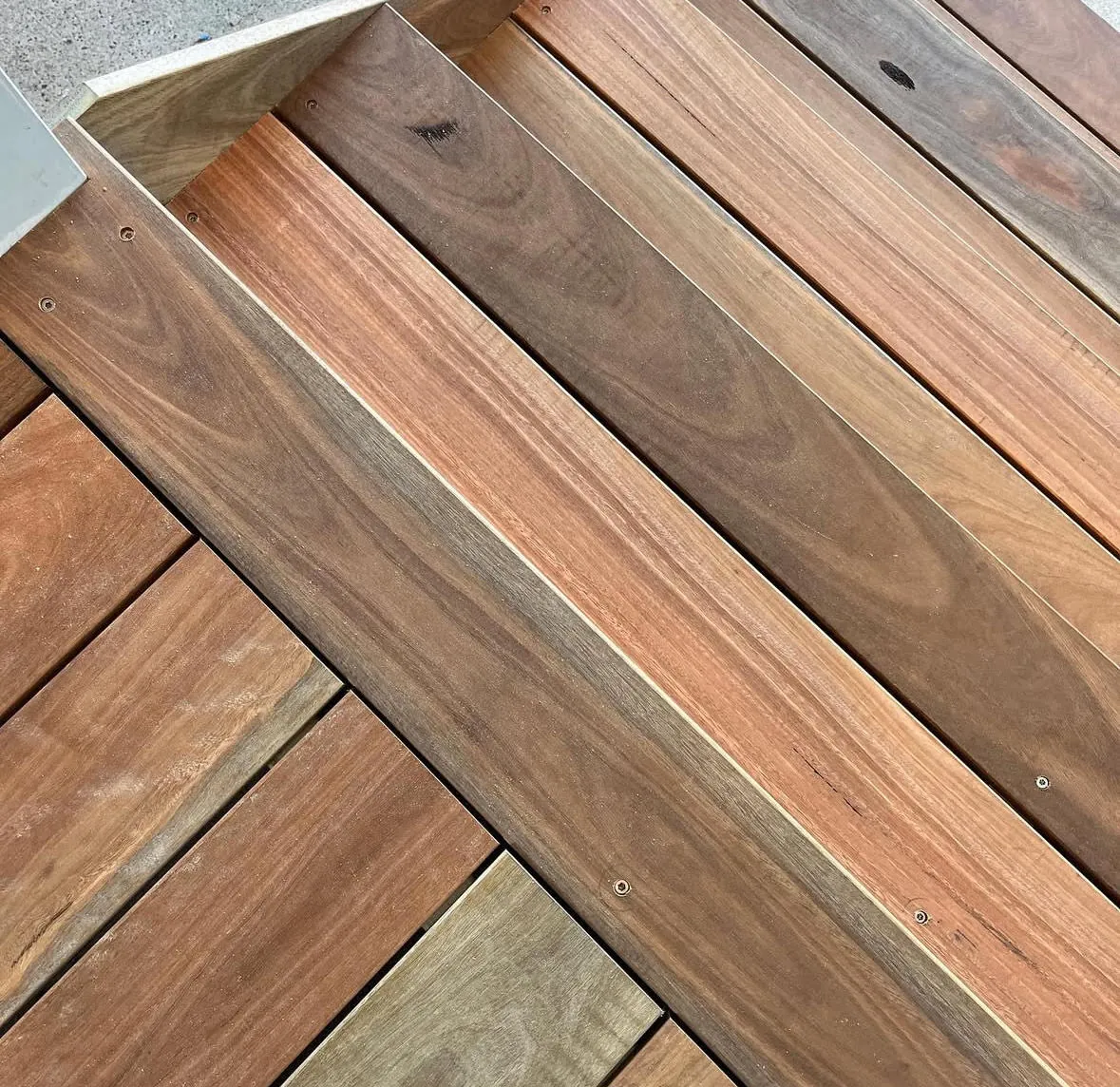
The spotted gum vs merbau decking decision is not a contest with one winner. We look at the setting, the owner’s preferred finish and the practical details around the deck. A pale rendered wall below the boards, a sunny west-facing edge or a need for verified sourcing can matter more than which species is fashionable.
Both are hardwood decking options, but they do not look or behave exactly alike. When planning timber decking, we want you to understand the variation in a real pack of boards, the finishing commitment and the implications of runoff before making the selection. A small showroom sample is a starting point, not a promise of uniform colour.
Where the timber comes from
Spotted gum: an Australian native hardwood
Spotted gum is an Australian native hardwood sourced from NSW and Queensland. The name covers a group of closely related species sold commercially as spotted gum, rather than a guarantee that every board will have identical characteristics. Ask what the supplier is supplying, where it comes from and what grading information accompanies it.
For owners considering spotted gum decking Central Coast conditions are only part of the decision; supply traceability matters too. Australian origin does not remove the need to ask sensible questions about responsible harvesting and chain of custody. If a certification claim matters to your purchase, ask for documentation that applies to the actual product being ordered.
Merbau: an imported hardwood
Merbau decking is imported from parts of South-East Asia and the Pacific. Origin and supply chains vary, so do not treat the species name as evidence of responsible sourcing. Ask the supplier for the country of origin, legal sourcing information and any independently certified chain-of-custody documentation relevant to that stock.
FSC or PEFC claims should be checked against the supplied product and documentation, rather than inferred from a logo on a website. If the supplier cannot substantiate the claim you need, choose another source or reconsider the material. We would rather resolve that before ordering than discover a mismatch after the boards are on site.
Colour and grain: choose a range, not a single board
Spotted gum commonly brings a mix of pale browns, warmer tones and deeper chocolate colours, with noticeable grain variation. That movement can suit a garden setting or soften a plain exterior. It can also disappoint someone expecting a flat, uniform surface. Look at several boards together and decide whether the variation is the feature you want.
Merbau generally offers a richer reddish-brown appearance, although boards still vary. It can sit comfortably alongside brickwork and warm interior timber, but colour relationships change in daylight. Put samples against the actual cladding, paving and door frames. An oil or other coating can deepen colour, and neither timber keeps its freshly installed appearance without a considered maintenance approach.
| Consideration | Spotted gum | Merbau |
|---|---|---|
| Origin | Australian native hardwood from NSW and Queensland. | Imported from South-East Asia and the Pacific; confirm source. |
| Appearance | Often varied brown tones and pronounced natural variation. | Typically reddish-brown, with variation between boards. |
| Runoff | Timber extractives can affect adjacent finishes. | Known for tannin bleed that can stain surrounding surfaces. |
| Outdoor performance | Durable hardwood; detailing and maintenance still matter. | Durable hardwood; moisture management remains important. |
| Budget | Depends on grade, profile, availability and installed scope. | Depends on sourcing, grade, profile and installed scope. |
| Bushfire design | Check the exact product and permitted application. | Check the exact product and permitted application. |
Tannin bleed and the surfaces below
Merbau is well known for releasing tannins when wetted, particularly early in its exposure. Runoff can stain pale paving, concrete, render and other absorbent finishes. On a raised deck, think about everything beneath it as well as the immediate edge. A tidy-looking deck can still create a difficult cleaning problem on the terrace below.
Spotted gum should not be treated as a guarantee of stain-free runoff either. Timber extractives and early weathering need consideration with any hardwood, especially beside light finishes. Before choosing, identify the water path from the boards to the garden or drainage system. Gutters, splash zones and neighbouring surfaces deserve attention during design rather than after the first rain.
Preparation needs a product-specific plan
Follow the timber supplier’s and coating manufacturer’s preparation instructions. Some systems require particular cleaning, weathering or preparation steps, and an improvised routine can compromise adhesion or create avoidable staining. Protect nearby surfaces during preparation and manage wash water responsibly. Do not assume a quick rinse will eliminate all future tannin release.
Durability is not the same as a maintenance-free deck
Both timbers are valued for outdoor durability, but that does not make every board or installation equally suitable. Species identification, heartwood and sapwood content, grading and treatment where relevant all matter. A durable board installed over damp, poorly ventilated framing can still be part of a short-lived deck. Details that let the structure dry are essential.
On the coast, sun, salt exposure and repeated wetting can be demanding on the whole assembly. The framing, connectors and fixings need to suit their exposure, and leaves should not be allowed to hold moisture between boards. Neither species removes the need for termite management or inspection access. Natural durability is not an assurance that termites will ignore the property.
Movement and installation
Timber changes dimension as its moisture content changes. Board width, moisture condition at installation, storage and ventilation all influence movement, cupping and checking. Merbau is often selected for its relative stability, but that is not a reason to disregard the installation specification. Spotted gum also needs careful storage, fixing and layout rather than being judged only by its density.
Bushfire suitability needs a separate check
If the property is bushfire-prone, do not approve either timber on appearance or a general statement that it is a hardwood. AS 3959, the assessed bushfire attack level and the relevant construction details can affect the decking, subfloor and nearby elements. The permitted material depends on the application and the requirements applying to that site.
The same early check should cover whether approvals are required for the deck itself. Our deck approval guide explains why choosing a material and choosing an approval pathway are connected but separate tasks. Sorting both before ordering avoids committing to boards that do not fit the accepted design.
Compare installed cost and ongoing care
Relative pricing shifts with availability, board dimensions, grade, certification and transport. Merbau is often considered a budget-conscious hardwood option, but that is not a reliable quotation rule. Preparation, waste, fixing labour and protection of surrounding finishes can change the installed comparison. Compare like-for-like specifications rather than a sale price for one board against a complete installed deck.
For merbau decking Central Coast owners should plan around tannin management as well as the chosen coating. For spotted gum, allow for natural variation and a finish that suits the desired colour. Both need cleaning and periodic review of the surface. Our coastal hardwood maintenance guide is a useful companion when deciding what care you are prepared to do.
If you want timber to retain a richer colour, accept that coating maintenance is part of ownership. If you prefer a weathered appearance, discuss that deliberately: greying does not remove the need to clean, inspect and manage moisture. Owners wanting a different maintenance balance can also read our timber and composite comparison.
How we would narrow the choice
- Look at several actual boards beside the house in daylight.
- Check the documented source, grade and available board profile.
- Map runoff onto paving, render and any usable area below.
- Resolve bushfire and structural requirements before ordering.
- Choose the preparation and coating system, then compare the complete installed scope.
Working directly with Elliot means those decisions can be considered together rather than handed between unrelated selections. Send the site photos and the finish you have in mind when you request a quote. The aim is a deck that suits the home and your maintenance habits, not a species recommendation detached from the job.
Questions
Frequently asked questions
Will spotted gum all be the same colour?
No, natural colour variation is part of its character. View several boards from the proposed supply and discuss how the layout will distribute lighter and darker pieces.
Does merbau always stain the paving?
Merbau can release tannins that stain absorbent surfaces, but the result depends on exposure, runoff and protection. Treat it as a design risk to manage rather than assuming every site will behave identically.
Can either timber be left to go grey?
Both can weather in colour, but a deliberate weathered finish still needs a maintenance plan. Cleanliness, moisture management and checks for surface or fixing problems remain important.
Is Australian timber automatically certified?
No, country of origin and independent certification are different things. Ask for traceable documentation for the actual stock if certification is part of your purchasing requirement.
Which timber is suitable in a bushfire area?
Suitability depends on the assessed BAL, application and relevant construction requirements. Confirm the exact product and assembly with the designer or certifier before buying either species.
Related services
Request a quote
Planning a deck, pergola or outdoor living space?
Tell us a little about your home and what you have in mind. Elliot will be in touch to arrange an on-site visit and talk through materials, design and budget.