
Maintenance · 8 min read
Signs Your Existing Timber Deck Needs Replacing
A tired finish is one thing; a weakened frame is another. Learn what to look for without putting yourself at risk.
Written by Elliot, carpenter and owner of Fine Design Co
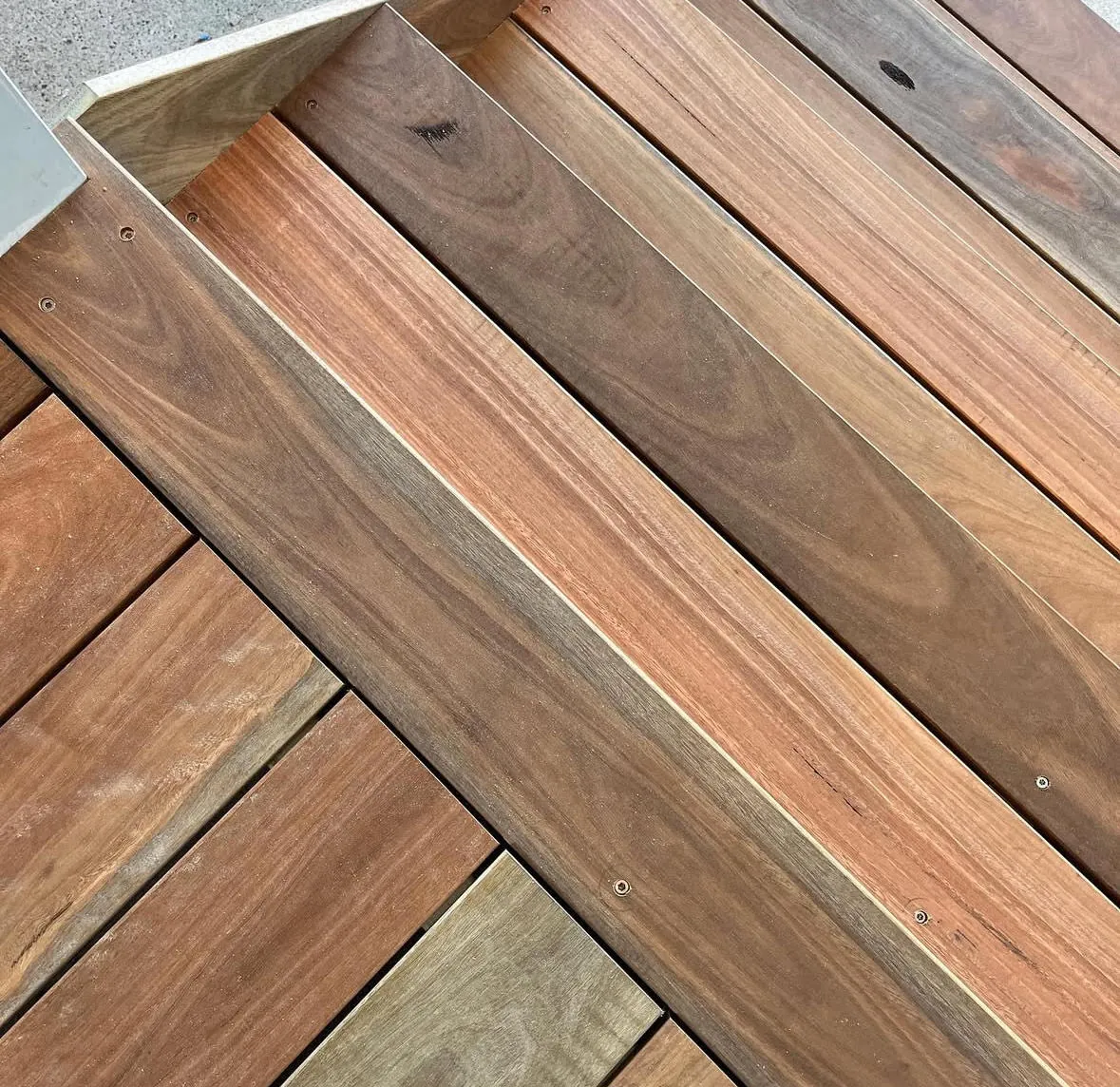
A grey deck does not automatically need replacing, and a freshly oiled deck is not automatically sound. The important question is what is happening at the supports, connections and damp spots you cannot easily see. When someone asks how long does a timber deck last, we look at its condition and construction rather than trying to give the timber an expiry date.
Species, exposure, drainage, ventilation, fixings and previous maintenance all affect service life. A board can dry out after rain while the joist beneath its fixing stays wet. Our approach to deck replacement is to separate cosmetic wear, isolated damage and structural problems before deciding what can sensibly remain.
Start with the boards, but do not stop there
Soft spots, cupping and splits
A soft or spongy board needs attention, especially around ends and fixings where water can enter. Look for sunken screw heads, crumbling fibres or areas that remain dark after the rest has dried. A split at a board end can reduce its grip around a fixing. A local problem may be repairable, but several similar failures suggest you need to inspect beyond the surface.
Cupping is the board curving across its width. It can hold water, create uneven edges and sometimes indicate uneven moisture conditions above and below the deck. Splits and surface checking vary in significance; fine weathering checks are not the same as a deep split through a fixing area. Do not decide structural adequacy from colour or one photograph.
The hidden trouble is often at the framing
Joist tops and bearers
The top of a joist sits beneath the boards, where moisture and debris can remain trapped. Decay may develop around fixing penetrations even when the joist sides look reasonable. Bearers, joist ends and crowded junctions deserve similar attention. Sometimes boards need to be lifted by a carpenter to see how far the damage extends; a glance from the garden is not enough.
If a replacement board has nothing sound to fix into, replacing the board alone is not a repair. The support beneath it must be assessed as well. We also look at why the area stayed wet: leaking gutters, trapped leaf litter, poorly detailed joints or limited airflow. Reusing the same damp arrangement can shorten the life of new work.
Posts, footings and the ground line
Timber posts at or near ground level can deteriorate where moisture lingers. Soil, mulch or garden beds built up around supports can hide their condition and make inspection difficult. Look from a safe position for leaning posts, visible decay, displaced supports or signs of settlement. Do not dig around a suspect footing or remove a connection to see whether it is still holding.
The concrete around a post may look intact while the timber itself has weakened. Equally, a sound-looking post does not establish that its footing is adequate or stable. Ground movement, drainage problems and support layout need to be considered together, particularly on sloping blocks where the downhill side is exposed to greater height and runoff.
Connections can fail before timber looks worn out
Rusted fixings and loose balustrades
Salt, moisture and incompatible metals can attack screws, bolts, brackets and connectors. Rust streaks are a prompt for closer assessment, not proof that the remaining metal is adequate. A bolt head can look better than the hidden shank, and a screw that snaps during removal may be telling you about more than that one fixing. Painting over rust does not restore lost metal.
Balustrades should not wobble in normal use. Loose posts, cracked timber around bolts, missing components or corroded connections deserve prompt attention because people naturally lean on them. Do not deliberately shake or load a suspect rail. Keep children and visitors away from unsafe edges until the problem has been assessed and made safe.
The ledger and house junction
Where a deck attaches to the house, the ledger or other connection must transfer loads into suitable structure. Warning signs include a widening gap, visible pulling at bolts, persistent dampness, rot or damaged cladding around the junction. Water entry can affect the house as well as the deck, so covering the area with a new trim is not a solution.
A carpenter may need to inspect concealed structure and flashing, with engineering or other specialist input where appropriate. The connection should not be assumed adequate just because it has been there for years. Adding a roof, changing the layout or retaining part of an old deck can introduce further demands on an already questionable junction.
Termites and movement need proper investigation
Termite damage can leave a deceptively thin outer shell around weakened timber. Mud leads, hollow-looking sections or unexplained damage warrant a licensed pest inspection; an absence of obvious insects does not rule it out. Avoid disturbing suspected termite activity or spraying it yourself before advice, as that can complicate the inspection. A carpenter assesses the resulting structural damage alongside the pest advice.
New bounce, sideways movement or creaking accompanied by visible displacement should not be dismissed as character. Movement may relate to loose fixings, damaged framing, supports or the house connection. Do not stage a bounce test. If movement is obvious during ordinary use, stop and arrange inspection rather than asking another person to stand at the far end.
A cautious homeowner checklist
Keep this inspection to areas you can safely reach from stable ground or a sound access point. Wear shoes and gloves, keep clear of projecting fixings and avoid lifting heavy boards. It is a screening exercise, not a structural inspection or permission to keep using a questionable deck.
- Look for uneven boards, open joints, persistent wet patches and missing fixings without walking onto a suspect area.
- Check visible post bases, stair supports and framing from outside the structure, not beneath unstable work.
- On accessible exposed timber only, gently press a screwdriver tip into a suspicious spot; unusually soft or crumbling fibres need assessment. Do not force the tool or use it to pry apart joints.
- Photograph rust, splits, gaps and moisture patterns from a safe position for the carpenter.
- Record whether movement or deterioration is new, then restrict access if safety is uncertain.
The screwdriver check is useful for finding obvious softness, but it cannot prove the remaining timber is sound. Hard paint, an intact surface shell or inaccessible joints can hide defects. Do not probe suspected termite areas, cables or concealed connections. If reaching the timber means climbing, removing a rail or getting under unstable framing, leave that part to the professional.
Repair, resurface or replace?
| What is found | Possible direction | What must be checked |
|---|---|---|
| Isolated damaged board | Local board replacement may be appropriate | Sound framing and a resolved moisture cause |
| Worn surface on sound structure | Cleaning, refinishing or resurfacing may be possible | Fixings, frame condition and compatible new boards |
| Repeated joist or bearer decay | Partial or full structural replacement may be needed | Extent of hidden damage and suitability of retained work |
| Weak house connection or unstable supports | Structural assessment before further use | Safe access, repair design and approval implications |
| Widespread deterioration | A complete replacement may be more sensible | New layout, drainage, materials and compliant details |
Resurfacing is attractive because the result is visible quickly, but old framing does not become new when the boards change. New board layouts or composite products can require different supports. Before choosing between composite and hardwood, establish whether the existing frame is suitable for either. Retaining doubtful structure can make a tidy-looking job poor value.
Replacement also gives you a chance to correct awkward stairs, water traps and an undersized landing. Our deck stair service considers the whole route, not just the tread surface. Approval requirements may change with the proposed scope, so review the NSW approval guide rather than assuming that calling it a replacement settles the matter.
What to bring to an assessment
Useful information includes photographs, any available original plans, previous repairs and where water sits after rain. Tell Elliot whether the priority is retaining the layout or redesigning the outdoor area. We focus on substantial replacement work, and an honest assessment may show that a wider rebuild is more sensible than a series of patches.
After the structure is sound, a sensible coastal maintenance routine helps keep dampness and corrosion visible. If you have noticed the warning signs above, request an assessment before oiling or painting over them. A better-looking surface should be the final step, not a way of postponing the important questions.
Questions
Frequently asked questions
How long does a timber deck last?
There is no reliable single lifespan for every deck. Timber selection, construction, moisture exposure, ventilation and maintenance all influence its condition. Assess the supports and connections rather than judging by age alone.
Does grey timber mean rot?
No, greying is often surface weathering from exposure. Rot involves deterioration of the timber and may show as softness, crumbling or loss of strength. Grey boards can be sound, while freshly coated boards can conceal problems underneath.
Can just the decking boards be replaced?
Possibly, if the frame, footings and connections are suitable and in sound condition. The new board system must also work with the existing support arrangement. Replacing the surface over decayed joists is not an adequate fix.
Is a loose balustrade an urgent problem?
Yes, treat it as a safety concern and keep people away from that edge. Do not test it by leaning harder or asking someone else to hold it. Arrange prompt professional assessment and a proper repair plan.
Should I use a screwdriver to check for rot?
Only gently on safely accessible exposed timber as an initial check for obvious softness. It cannot certify the structure and should not involve dismantling, force or access beneath an unsafe deck. Leave suspected termite damage undisturbed for a pest professional.
Can replacement fix drainage problems too?
It provides an opportunity to address water traps, ground levels and access to drainage. The cause may also involve roof runoff or surrounding landscaping, so the deck alone may not solve it. Include those conditions in the replacement scope from the beginning.
Related services
Request a quote
Planning a deck, pergola or outdoor living space?
Tell us a little about your home and what you have in mind. Elliot will be in touch to arrange an on-site visit and talk through materials, design and budget.